Industrial IoT Platform
Monitor every machine in the field from a single control room
Track Thing brings your assets, devices and sensor data together. It runs your threshold rules, flags degradation early and alerts your team at the right moment.
- Collect readings from your devices within seconds
- Catch NORMAL → WARNING → ALARM state transitions automatically
- Run it in the cloud or on your own servers — the data stays with you
Our team works alongside you through onboarding and the pilot phase.
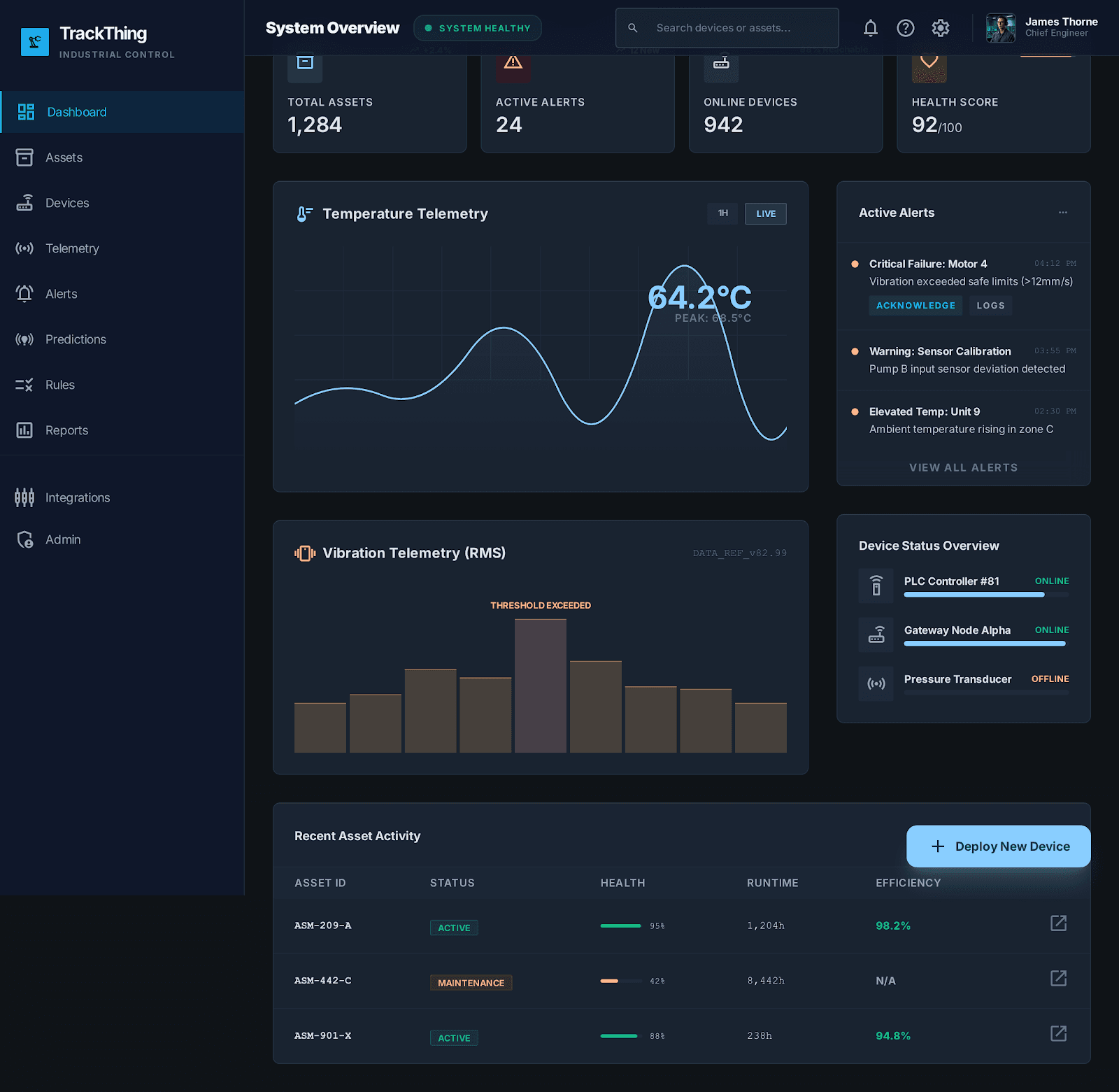
Total assets
1,284
Online devices
942
Active alerts
24
Health score
92/100
- Motor 4 — vibration threshold exceededALARM
- Pump B — sensor calibration driftWARNING
- Zone C — ambient temperature risingINFO
Why it matters
You cannot manage what you cannot see
Most plants already have the data — just never in one place. Track Thing was built to close these three gaps.
The field lives in a spreadsheet
Assets in Excel, sensor data in the PLC, maintenance history somewhere else. Nobody sees the current state on one screen.
Asset hierarchy, device status and telemetry come together in one console.
You learn about a failure when the machine stops
Unplanned downtime, emergency service calls and delayed production. By the time you hear about it, it is too late.
Threshold rules and prediction jobs flag degradation before the stop.
Every device speaks its own language
Different vendors, different protocols, different formats. Every integration turns into its own project.
Device attribute schemas and an API layer reduce it all to one model.
How it works
Five steps from sensor to decision
Each step runs independently, yet the chain never breaks: data flows without loss, enters the rule engine and reaches the right person.
- 01
Collect
Devices send their readings automatically; a new device commissioned in the field registers itself.
- 02
Store
Every incoming reading is processed in order and stored for good. Raw data is not summarised away — it stays queryable as a time series.
- 03
Analyse
Threshold rules and separately running prediction jobs evaluate the data, producing health scores and risk indicators.
- 04
Alert
A state transition produces a notification that reaches organisation members in real time.
- 05
Report
Dashboards and telemetry exploration let engineers dig into detail while management reads the summary — from the same data.
Platform
Six modules, one platform
Each module stands on its own; together they close the monitoring and predictive maintenance loop.
Asset Management
Manage sites, lines, machines and components in one tree; follow each asset's status and 0–100 health score.
Learn moreDevice Management
Register gateways and sensors in the field; track online status, last-seen time and firmware version.
Learn moreTelemetry and Time Series
Sensor data is processed in order and stored; metric-level series are explored on charts.
Learn morePredictive Maintenance
Incoming readings are evaluated continuously; prediction results are stored and feed the alert chain.
Learn moreRule Engine and Alerts
Define metric-level thresholds so your team is notified the moment a target moves between NORMAL, WARNING and ALARM.
Learn moreIntegration and Reporting
Connect the platform to your existing systems through a documented API and organisation management.
Learn moreInterface
An interface that feels like a control room
A dark theme built for long shifts, high data density and technical charts. Images are taken from the product interface design.
Solutions
Configured for your industry
One platform, different field realities. Scope and tracked metrics change with the industry.
Why Track Thing
Not a black box — a platform you control
Collecting industrial data is easy; keeping it safe and queryable for years is the hard part. Track Thing was designed for the second one.
No vendor lock-in
It works with widely used industry standards — you are never locked into a proprietary protocol or a single hardware brand.
Cloud or your own servers
Deployed on your own servers or in a managed cloud. You decide where the data lives.
Multi-organisation by design
Separate organisations per site, dealer or customer; membership, invitations and roles come built in.
Raw data is kept
Telemetry is not summarised and discarded. When a new question comes up, you can go back to the history for the answer.
FAQ
Frequently asked questions
How long does deployment take?
It depends on device count and site access. The flow is always the same: register devices, connect telemetry, define threshold rules and roll out the dashboard. We plan those steps with you as part of the pilot.
Which devices does it work with?
It works with any device that can send its readings over common industry protocols. Device-specific fields such as serial number or signal strength are added through definitions, so hardware from different manufacturers ends up in one inventory.
Can we migrate data from our current system?
Yes. Asset and device records can be imported in bulk through the API, and we plan an import path for historical telemetry.
Where is our data stored?
On your own infrastructure the data never leaves it. In a managed deployment you choose the region where it is kept — in both cases the data is yours.
How does predictive maintenance work?
Incoming readings are evaluated continuously; when a degradation trend appears the risk indicator rises and the threshold and alert chain kicks in. The models themselves are developed together, around your equipment and use case.
Which languages does the interface support?
The product interface ships in Turkish and English. Additional languages can be evaluated on request.
Let's make your field visible
In a short demo we show how Track Thing works on your own assets.